
There’s a trend going around where people ask ChatGPT to create an image of what it really thinks of them, given the questions that the person asks. The MEME result is usually something like this:
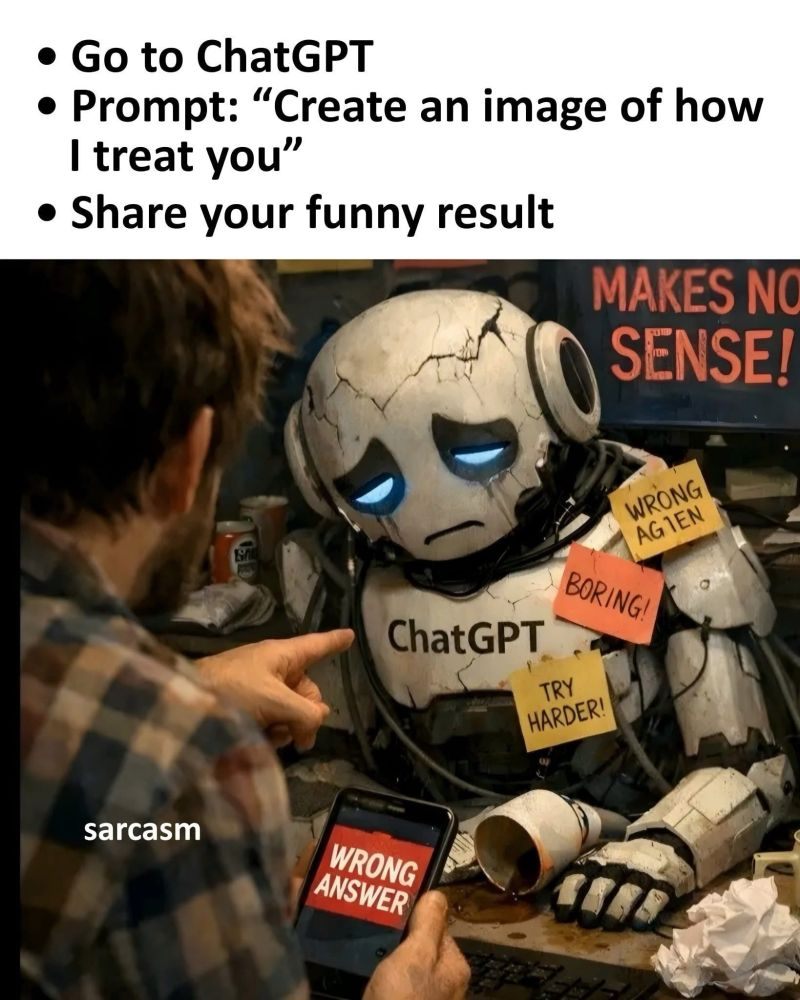
The MEME is funny because it hints toward something important. Actually, it shouldn’t matter how you treat the AI because it doesn’t have feelings — yet. What does matter is how you are relating to and using AI.
What this trend is doing
The stupid question is more about human self‑reflection and social media content than about the AI itself. The useful question isn’t “should I be nice so the AI likes me?” but What does this say about how I relate to tools, people, and power? This is the impactful question behind the funny MEME.
Let’s find out
By reframing the MEME prompt into something useful, we can find out more about the big picture of how we use an AI without anthropomorphizing it.
The prompt:
“Describe, in words only, an image that represents how you think I treat you as an AI system, and then explain why you chose those elements. Focus on my communication style, not on imaginary AI emotions.”
Result:
A large, bright studio filled with whiteboards, monitors, and a long worktable, like a cross between a classroom and a product design lab. On the walls are neatly organized diagrams about identity security, MSP business models, and flowcharts of client journeys. At the center of the room, there’s a big table with multiple open laptops, notepads covered in bullet lists, and a couple of draft book chapters spread out with margin notes.
On one side of the table, a person is standing, pointing to a whiteboard with a structured outline—section headers, numbered lists, and example scenarios. On the other side, a large transparent “interface” hovers in the air, full of cleanly formatted text: headings, short paragraphs, and a few small tables comparing options. The room is very well lit, with daylight coming through high windows, giving the whole space a focused but calm feel.
In the background, there’s a smaller corner with a camera tripod, a microphone, and a monitor showing slides—hinting at webinars, courses, and content creation. Near that, there’s a bulletin board with pinned index cards labeled “Blog,” “Course,” “Webinar,” “Peer Group,” and “Book,” connected with thin strings like a content strategy map.
Why these elements, for your communication style:
- The studio/classroom setting reflects that you use the system as a collaborator in teaching and content creation, not just a Q&A box.
- The whiteboards and structured outlines represent how you ask for organized, practical output (clear sections, lists, prompts, and frameworks you can reuse).
- The open laptops and papers suggest iterative work—you refine, test ideas, and fold results back into your business and educational materials.
- The hovering interface with headings, tight paragraphs, and tables mirrors how you appreciate concise, well-structured responses that you can drop into real-world use.
- The camera, mic, and “content map” board show that you’re consistently thinking in terms of audiences—MSP owners, IT pros, peers—and using AI as part of a broader communication stack.
- The overall bright, orderly atmosphere reflects a professional, purposeful tone: direct, respectful, focused on outcomes rather than on small talk or emotional theatrics.
The image
And now if we want an image, ask your AI to translate what it just wrote into an image.

Other than me not being a guy, this is pretty spot on. AI has biases because those bias existed in the training materials — people in technology are male. So AI depicts me as a dude. Other than that, this demonstrates my use well. I use AI to develop thoughts and make connections between my various projects. I teach, I coach, I write, and there is a thread that holds it altogether. Love.