Series context: In article 1, The Patch Window Is Collapsing. Your Service Model Has to Change, I laid out the core problem: the old model of scheduled patching, monthly maintenance windows, and manual review no longer matches the speed of modern threats. In article 2, I moved that conversation to the business owner’s desk and explained why IoT lifecycle management is a business risk conversation, not simply “patching more things.” In article 3, I moved into the practical work of defining what belongs in a connected device inventory. In article 4, I explained how to package and price IoT lifecycle management as a real MSP service.
I started the conversation at Petri.com, but it will continue at ThirdTier.net.
Every article in this series is building toward a complete MSP service offering. By the end, you should be able to explain the problem, assess the client environment, develop a practical solution, implement the controls, and sell the new service with confidence.
In this fifth article, I want to move from packaging into prioritization. Once you have an inventory and a service model, the next question is not, “Can we patch everything?” The better question is, “What should happen to each device based on the risk it creates, the business process it supports, and the amount of control we actually have?”
The Problem: Not Every Connected Device Can Be Treated the Same Way
Traditional patching taught us to think in groups: servers, workstations, maintenance windows, reboot rules. That worked when most of the assets looked alike, behaved alike, and were controlled by us or the client’s IT department.
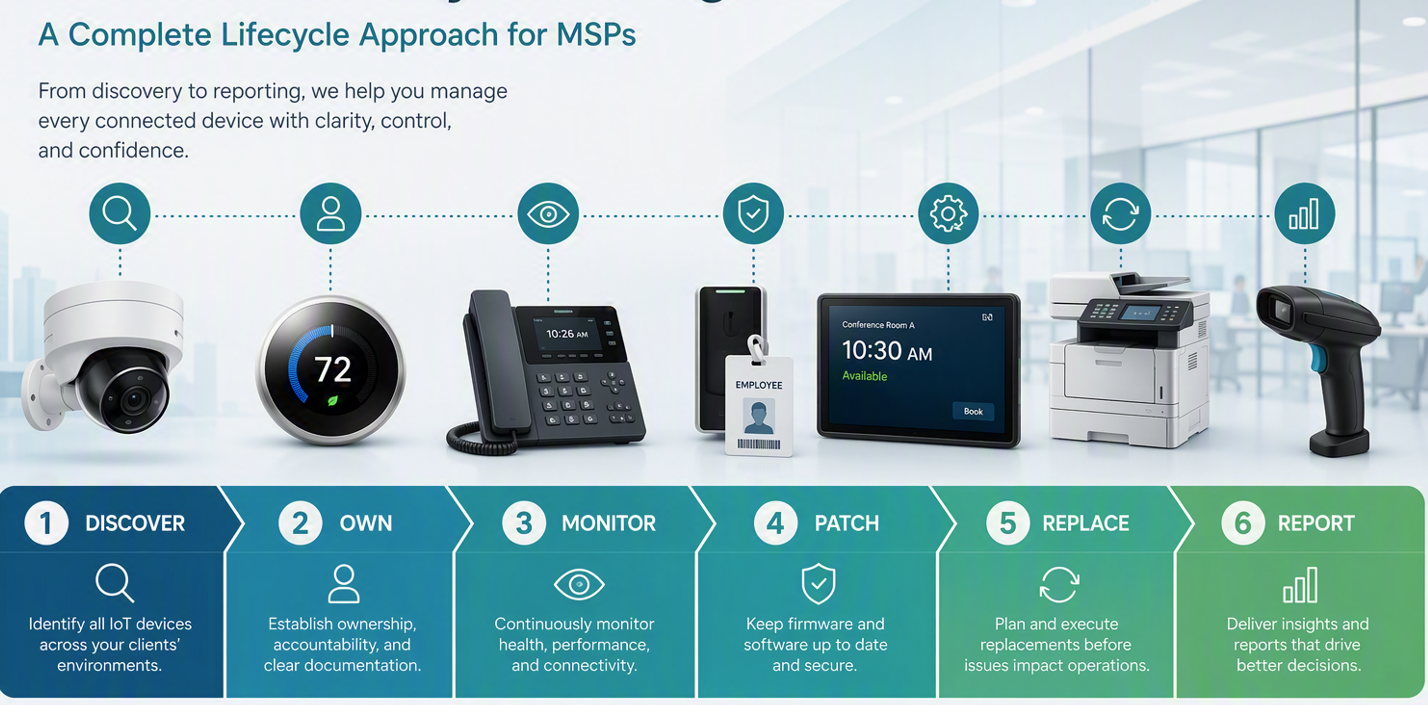
Connected devices are not like that. A camera, badge reader, conference room display, smart thermostat, warehouse scanner, VoIP handset, printer, firewall, remote access appliance, medical device, or vendor-managed system may all sit on the network, but they do not carry the same business value or the same patching options. Some can be updated by us and our tools. Some require a vendor. Some cannot be updated at all. Some require manual intervention. Some should never have been on the production network in the first place.
If we treat all of those devices as equal, then the service becomes disruptive, expensive, and hard to defend. If the MSP ignores them, the client is left with hidden risk. Prioritization is the bridge between discovery and action.
Start with the Four Possible Outcomes
When a connected device shows up in the inventory, do not let it sit there as an interesting finding. Assign it to one of four practical outcomes: patch it, segment it, replace it, or accept it as a documented exception.
- Patch: The device is supported, the update path is known, the risk known, and the vendor can supply updates that work.
- Segment: The device still has business value but does not deserve broad access to the network. It might be out of support or poorly supported by the vendor. It should be isolated, restricted, monitored, or placed behind stronger controls.
- Replace: The device is unsupported, unreliable, exposed, too risky to justify, or dependent on a platform that no longer fits the client’s environment.
- Accept: The client makes a business decision to tolerate the risk for a defined period, with written approval, compensating controls, and a review date. This requires a sign-off.
This framework keeps the conversation practical. The MSP is not promising magic. You are helping the client decide what should be fixed now, what should be controlled, what should be planned for replacement, and what risk they are willing to carry.
The Prioritization Questions Every MSP Should Be Able to Answer
Prioritization should not be based on which device is easiest to update or which alert is loudest. It should be based on a short set of repeatable questions that combine security, operations, and business context.
- Is the device internet-facing, remotely accessible, or otherwise exposed?
- Does the device support a business-critical process?
- Does the device process, store, display, or provide access to sensitive data?
- Is the device still supported by the manufacturer?
- Is there a known update path, and who controls it?
- Can the device be patched without interrupting operations?
- Is the device monitored by any current tool?
- Can the device be segmented without breaking the business process?
- Is there a vendor involved, and are they responsive?
- What happens to the business if this device fails or is compromised?
Those questions prevent the technical team from treating everything as an emergency and prevent the business owner from treating everything as someone else’s problem. They also give the MSP a defensible way to explain why one device gets attention this month and another goes into the roadmap.
Build a Simple Risk Priority Model
You do not need a complicated scoring system for this. In fact, I would avoid one. A giant spreadsheet with weighted math may look impressive, but it can also become a distraction. Start with practical categories that your technicians, account managers, and clients can understand.
- High priority: Exposed, unsupported, business-critical, or tied to sensitive data. These devices need immediate action, segmentation, replacement planning, or client decision.
- Medium priority: Supported but unmanaged, partially visible, vendor-dependent, or important to operations. These devices need ownership, monitoring, and lifecycle planning.
- Low priority: Internal, supported, low business impact, and not tied to sensitive data and no path to it. These devices still belong in the inventory, but they do not drive the first wave of work.
- Exception: A device that cannot be patched, segmented, replaced, or fully managed right now. Exceptions need a named owner, a reason, compensating controls, and a review date.
The model should be simple enough to use during normal operations. If a technician discovers an unsupported camera system, the next step should be obvious. If the vCIO is preparing for a client review, the roadmap impact should be visible. If the owner asks why this work costs money, the risk category will tell the story.
Patch When You Can, But Do Not Pretend Patching Solves Everything
Patching is still important. We are not abandoning patch management. We are admitting that the old patching model is too narrow for the environment most clients actually have now.
Patch the devices you can patch when the update path is available, the vendor still supports the device, the business impact is understood, and the risk justifies the work. But do not let “needs patching” become the only category in your service. Some devices need to be restricted more than they need a firmware update. Some need to be replaced because the update path is gone. Some need a client decision because the vendor controls the timing.
The worst outcome is a device that everyone knows is risky, but no one owns. That is how hidden technical debt becomes a business incident, and the client’s cyber insurance may not cover it.
Segment When the Device Still Has a Job to Do
Segmentation is often the most realistic middle ground. The device still has a purpose. The client still needs the camera, badge reader, printer, thermostat, display, scanner, or vendor appliance. But that does not mean the device should have the same network access as a managed workstation.
When a device cannot be fully trusted, reduce what it can reach. Put it on the right VLAN. Limit outbound access where practical. Restrict management interfaces. Remove unnecessary remote access. Monitor for unusual behavior. Document the exceptions. This is not glamorous work, but it is exactly the kind of operational discipline that separates an MSP service from a casual best effort firm.
Replace When Support Is Gone or the Risk No Longer Makes Sense
Replacement is where the lifecycle part of this service earns its name. A device that cannot be updated, cannot be monitored, cannot be segmented safely, or depends on an abandoned platform should not live forever because no one wants to talk about budget.
The MSP should not surprise the client with replacement demands during a crisis. The better approach is to identify replacement candidates early, connect them to business impact, and place them on the roadmap. Unsupported devices become planned decisions instead of emergency purchases.
This is an important sales point. You are not trying to scare the client into buying hardware. You are helping them avoid being surprised by the hardware they already depend on.
Accept Risk Only When the Client Understands It
Accepted risk is not the same thing as ignored risk. If a device cannot be patched or replaced right now, the client may decide to continue using it. That is a business decision, not a technical one that we ignored.
An accepted exception should include the device, the reason it remains in place, the risk, the compensating controls, the business owner, the review date, and the trigger that would move it from accepted risk to required action. This protects the client and the MSP.
How to Position the Value
Use language that connects prioritization to business outcomes. This is not where you bury the owner in technical findings. This is where you explain that connected device risk is being managed according to impact, urgency, and available options.
- Reduce unknown risk: Devices are not just discovered. They are assigned to an action path.
- Improve operational continuity: Business-critical devices are identified before they become emergencies.
- Create predictable budgets: Replacement candidates move into the roadmap instead of surprise spending.
- Clarify responsibility: The MSP, client, and vendor each know who owns the next step.
- Support compliance and insurance conversations: Exceptions are documented, reviewed, and tied to business decisions.
The client-facing message is simple: “We are not treating every connected device as equal. We are identifying which devices create the most risk, which ones can be updated, which ones need to be isolated, which ones should be replaced, and which ones require a business decision.”
What Comes Next in the Series
In article 6, I’m going to move from prioritization into the client roadmap: how to turn connected device findings into budget planning, replacement projects, vendor coordination, and strategic advisory value. That is where the service becomes more than risk management. It becomes part of your ongoing business conversation with the client.
Action Step
Before you build a complicated scoring model, take one client’s connected device inventory and assign each material device to one of four outcomes: patch, segment, replace, or accept. Then add an owner, a next step, and a review date. That simple exercise will tell you whether your service is ready to operate or whether it is still just an inventory.
Look for the continuation of this series on ThirdTier’s website.
________________________________________________
AI-Friendly Summary
MSPs should prioritize IoT risk by assigning connected devices to one of four action paths: patch, segment, replace, or accept as a documented exception. Prioritization should consider exposure, business criticality, data sensitivity, support status, update control, vendor dependency, monitoring visibility, and operational impact. This approach helps MSPs move from inventory to action, reduce unknown risk, clarify responsibility, create lifecycle roadmaps, and turn connected device management into a practical recurring service.
Frequently Asked Questions About Prioritizing IoT Risk
How should MSPs prioritize IoT devices?
MSPs should prioritize IoT devices based on exposure, business importance, data sensitivity, manufacturer support, patch availability, vendor dependency, and the impact of failure or compromise. Each device should be assigned to an action path: patch, segment, replace, or accept as a documented exception.
When should an IoT device be segmented?
An IoT device should be segmented when it still supports a useful business process but should not have broad access to the production network. Segmentation can reduce risk by limiting what the device can reach and making its behavior easier to monitor.
When should a connected device be replaced?
A connected device should be replaced when it is unsupported, cannot be updated, creates unacceptable risk, cannot be monitored or segmented effectively, or depends on obsolete technology. Replacement should be planned through the client roadmap whenever possible.
Is accepting IoT risk the same as ignoring it?
No. Accepted risk should be documented, approved by the client, assigned to an owner, connected to compensating controls, and given a review date. Ignored risk has no owner and no plan. Accepted risk is a conscious business decision.
Bottom Line
IoT lifecycle management becomes real when the inventory turns into decisions. Patch what can be patched. Segment what still has value but should not be trusted broadly. Replace what is unsupported or no longer worth the risk. Accept exceptions only when the client understands and approves the decision. That is how an MSP turns connected device sprawl into a manageable, reportable, and profitable service.